Engineering · Ventilation
Building ventilation — designing healthy airflow
Ventilation is the single most important lever for indoor air quality. This deep-dive walks through how modern buildings move, filter and recover air — with diagrams and engineering benchmarks.
Three strategies
Natural · Mechanical · Hybrid
Every building uses one — or a blend — of three ventilation approaches. The right choice depends on climate, occupancy density and acoustic requirements.
STRATEGY 01
Natural
Cross & stack ventilation, openable façades.
STRATEGY 02
Mechanical (MVHR)
Heat recovery balanced supply + extract.
STRATEGY 03
Hybrid mixed-mode
Switches between natural and mechanical.
OPTIMISATION
Demand-controlled
CO₂-driven dampers modulate fresh air per zone.
Filtration
F7-F9 / MERV 13+ for PM2.5 control.
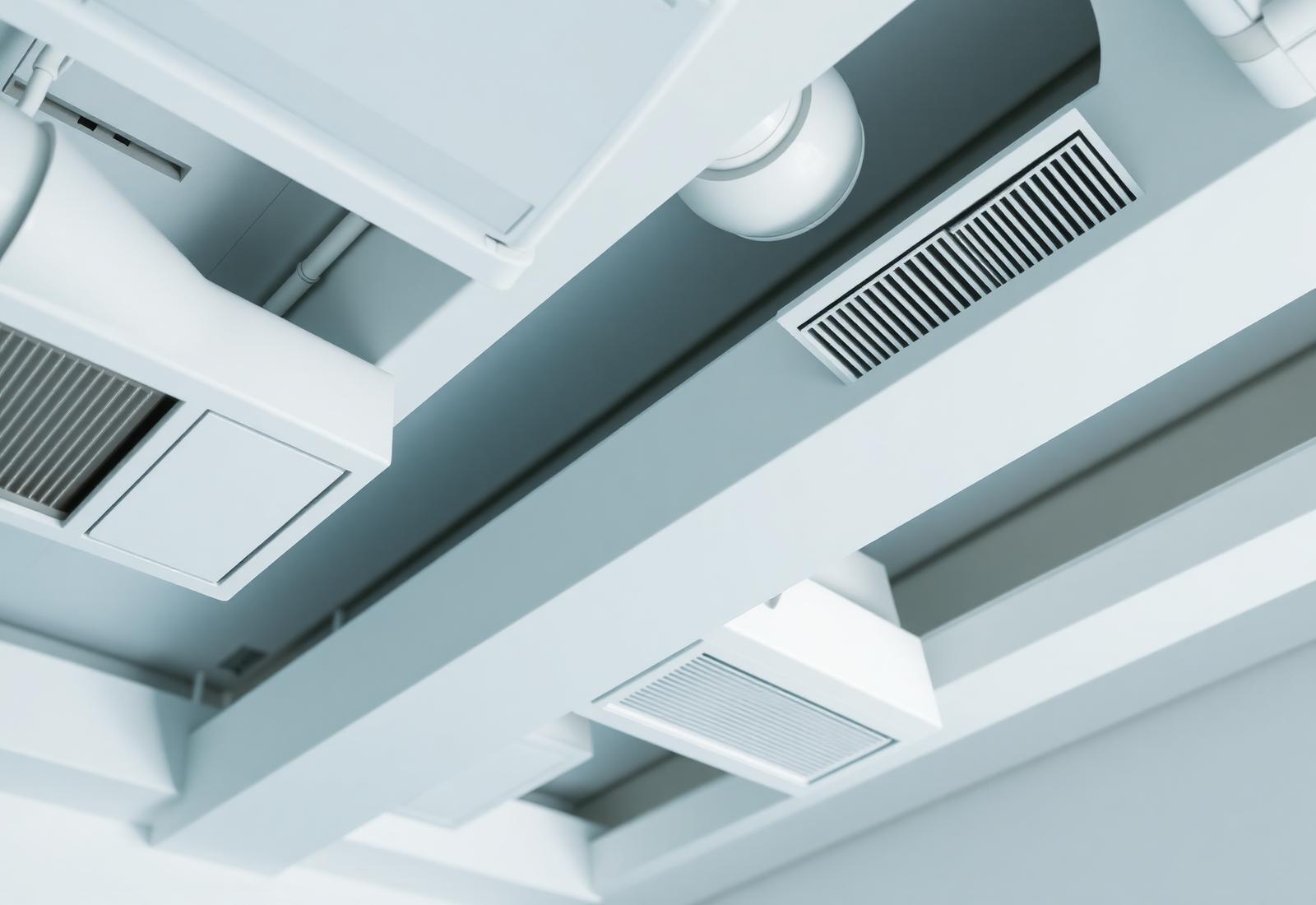
Typical commercial diffuser & duct arrangement
MVHR explained
Mechanical ventilation with heat recovery
MVHR systems extract stale, moist air from kitchens and bathrooms while supplying tempered, filtered fresh air to bedrooms and living spaces. A heat exchanger transfers up to 90% of warmth from outgoing air to incoming.
Properly commissioned MVHR delivers continuous high IAQ with minimal energy penalty — the cornerstone of Passivhaus and modern airtight construction.
Process
Designing ventilation right — first time
- 1
Step 01
Occupancy analysis
Map peak densities and dwell times across zones to size outdoor air rates per CIBSE TM52 / ASHRAE 62.1.
- 2
Step 02
System selection
Choose between MVHR, displacement, mixing or hybrid based on heating strategy and acoustics.
- 3
Step 03
Commissioning
Balance flow rates, validate filter performance and verify against design intent.
- 4
Step 04
Continuous monitoring
CO₂ and PM sensors confirm performance through years 1-10.
Engineering benchmarks
Outdoor air rates by space type
| Space | Outdoor air (l/s/p) | CO₂ target |
|---|---|---|
| Open-plan office | 10 | <800 ppm |
| Meeting room | 12 | <1000 ppm |
| School classroom | 8-10 | <1000 ppm |
| Residential bedroom | 5 | <1000 ppm |
| Healthcare ward | 10 | <800 ppm |

Airflow intelligence
The invisible infrastructure of healthy buildings.
Every breath taken inside a modern building has been moved, filtered and tempered by systems few occupants ever see.
Need a ventilation assessment?
Independent expert review of supply rates, filtration grades and system performance.
Book ventilation assessmentPollutants
Healthy buildings