Workplace · Modern offices
Office air quality — the silent driver of workplace performance
The air in your office shapes how your teams think, feel and recover. From CO₂ and VOCs to humidity and particulates, workplace IAQ is now a measurable lever for retention, focus and wellbeing.
Productivity uplift
+11%
when CO₂ kept below 800 ppm
Sick days
−35%
in well-ventilated offices
Hours indoors
~50 / week
average UK office worker
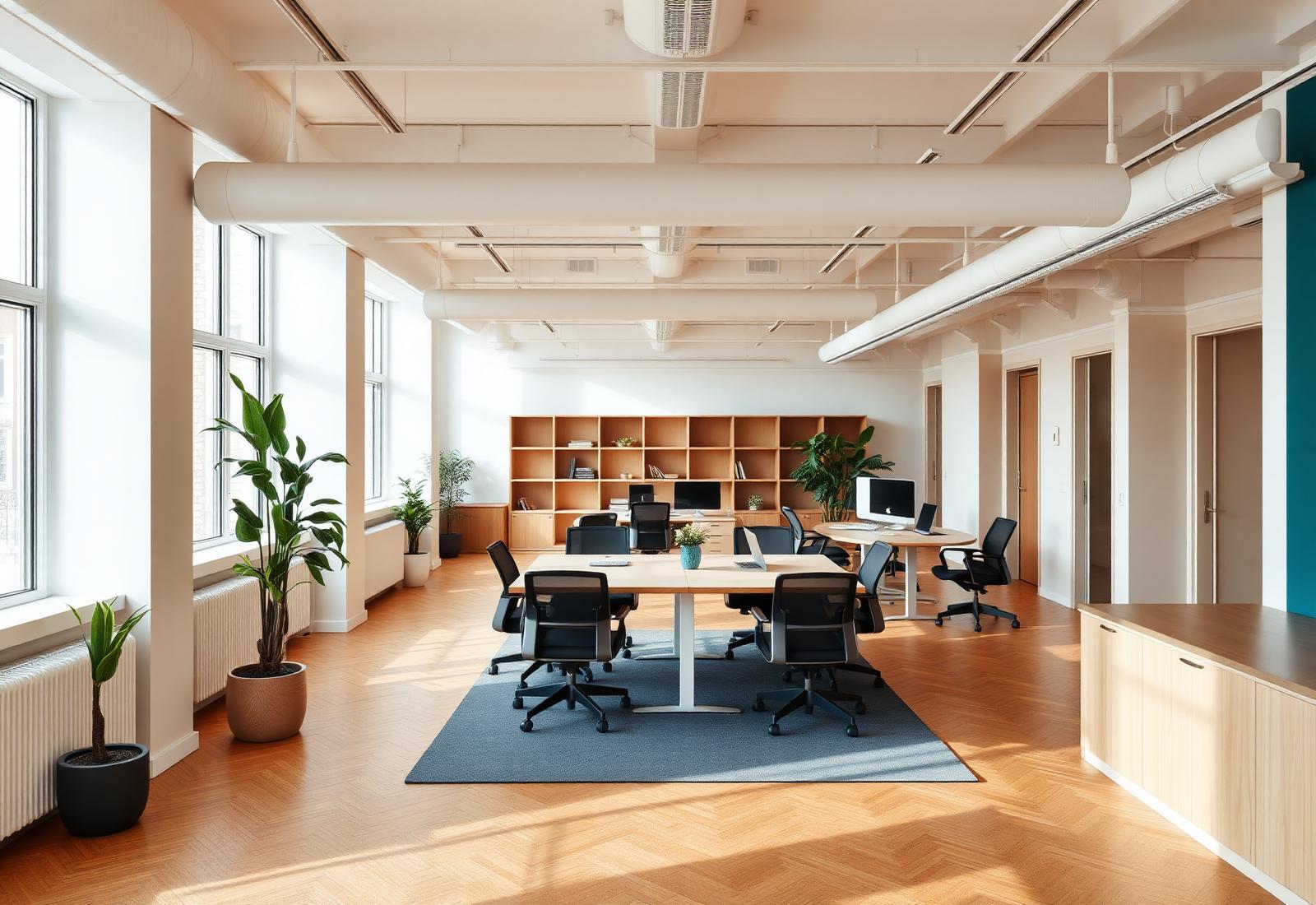
Modern workplace IAQ
Open plan, mechanical ventilation, dense occupancy.
The defining IAQ challenge of the modern office is balancing energy efficiency with the outdoor air rates needed to keep occupants sharp.
Why it matters
Air is the most under-managed workplace variable
Offices measure energy, occupancy, even desk utilisation. Air, until recently, was managed by exception. That gap mattered less when most knowledge work happened in low-density rooms with openable windows. It matters now because the average modern office is denser, more sealed, and home to longer stretches of cognitive work than at any point in its history.
The case for change is no longer theoretical. The Harvard COGfx studies measured an 11% improvement in cognitive scores when CO₂ moved from 1400 to 600 ppm, and a further 8% when VOCs were halved. The findings have been replicated in office cohorts in Boston, Beijing and London. For a knowledge-work organisation, indoor air sits in the same conversation as lighting and ergonomics.
The operational story is similar. Studies of mechanically ventilated offices consistently show 30–40% lower sick-day rates when outdoor air supply is brought up to BS EN 16798-1 Category II. The marginal cost of the additional ventilation is a fraction of the avoided absenteeism.
The big four
Pollutants every office should monitor
A workable monitoring set covers the indicators that drive most occupant complaints and most measurable health effects.
1000
ppm CO₂
Action threshold for offices
12
l/s/p
Outdoor air per occupant (CIBSE)
F7+
Filter grade
Recommended for urban offices
50%
Ideal RH
Reduces virus survival and dryness
Cognitive scores were 61% higher in green building conditions than in conventional offices — and doubled again when outdoor air was further increased.
Symptoms
What poor office air actually feels like
Afternoon brain fog. Dry eyes. Headaches in meeting rooms. Lethargy after lunch. A persistent stuffiness that no thermostat seems to fix. These are not personal failings, and they are not a coffee problem. They are predictable physiological responses to elevated CO₂, accumulated VOCs and dry air.
The diagnostic pattern is consistent. Symptoms emerge during the working day, peak in late afternoon, and resolve within an hour of leaving the building. They cluster by zone — the meeting rooms on the south side, the dense bank of desks furthest from the AHU. They worsen on full-occupancy days. Where the pattern matches, the cause is almost always engineering, not medicine.
Ventilation
Demand-controlled ventilation, not fixed schedules
The dominant ventilation pattern in older offices runs the AHU at a fixed rate during occupied hours, regardless of how many people are actually in the building. With hybrid working, that strategy fails twice — under-ventilating peak days and wasting energy on quiet ones.
Demand-controlled ventilation links outdoor air supply to CO₂ measurements taken in the breathing zone. When meeting rooms fill, the AHU brings up the outdoor damper and supply fans respond. When the space empties, ventilation falls back. The result is consistent indoor air across variable occupancy, with energy use that scales naturally with use.
The retrofit cost is modest compared with the avoided absenteeism. The data trail it produces is the by-product that auditors and tenants now ask for. Diagnosing ventilation problems →
Investigation
From complaint to evidence-led fix
A structured office IAQ investigation moves from symptoms to root cause within two to four weeks.
- 1
Step 01
Occupant survey
Standardised symptom questionnaire across the affected zone and a control zone. Establishes prevalence and rules out medical-cause clustering.
- 2
Step 02
Continuous baseline
Two to four weeks of CO₂, PM, temperature and humidity monitoring at desk height. Shows whether complaints track occupancy, time of day or external conditions.
- 3
Step 03
Targeted sampling
Sorbent-tube VOC speciation, formaldehyde, and surface sampling where damp or microbial growth is suspected. Aligns laboratory findings with the live data.
- 4
Step 04
Engineering action
Outdoor air uplift, filter upgrade, AHU clean, source removal — sequenced from highest-impact to lowest-cost. Closes with re-measurement to verify the outcome.
FAQ
Common office IAQ questions
Audit your workplace air quality
Independent IAQ assessment plus continuous monitoring rollout — designed for modern hybrid offices.
Workplace IAQ overviewOffice topics
Pollutants