Understanding Indoor Air Quality in Modern Buildings
Independent guidance, monitoring insights, ventilation expertise and healthy building resources designed for healthier indoor environments — across homes, offices and commercial spaces.
Evidence-Based
Independent guidance
Building Health
Healthy buildings expertise
Monitoring & Ventilation
Specialist insights
Real-Time Monitoring
Track PM2.5, PM10, VOCs, CO₂ and humidity continuously.
ExploreVentilation Analysis
Identify under-ventilated spaces and HVAC weaknesses.
ExploreHealthy Buildings
WELL & BREEAM-aligned strategies for occupant health.
ExploreIAQ Expertise
Evidence-based guidance from environmental specialists.
ExploreIndoor Environmental Intelligence
We spend 90% of our lives indoors. The air there shapes everything.
Real data on what's actually circulating in offices, homes and public buildings across the UK.
5×
More polluted than outdoor air
1,400+
Buildings monitored
PM2.5
Tracked continuously
WELL
Standard aligned
№ 01 — Knowledge Atlas
A complete map of the air around you.

Indoor Air Quality, decoded.
What IAQ actually means, why it matters, and how to measure it across modern buildings.
Read the deep diveSick Building Syndrome
Recognising symptoms, causes and remediation in affected workplaces.
Office Air Quality
Standards, ventilation problems and the link to productivity.
Ventilation
MVHR, HVAC & ASHRAE-aligned design.
Monitoring
Sensors, protocols & frameworks.

Healthy Buildings
WELL · BREEAM · standards.

Live Sample
12 μg/m³
PM2.5 · 24h avg
Within WHO target
№ 02 — Pollutant Intelligence
Know exactly what's in the air you breathe.
From volatile organic compounds to fine particulates and CO₂ — explore the pollutants shaping indoor environments.
"Indoor air quality is the most underappreciated public health factor of our generation. The buildings we occupy are silent contributors to chronic disease — or quiet enablers of human flourishing."
Healthy Buildings Research
Harvard T.H. Chan School of Public Health
№ 03 — Independent Services
Diagnose your building. Breathe with confidence.
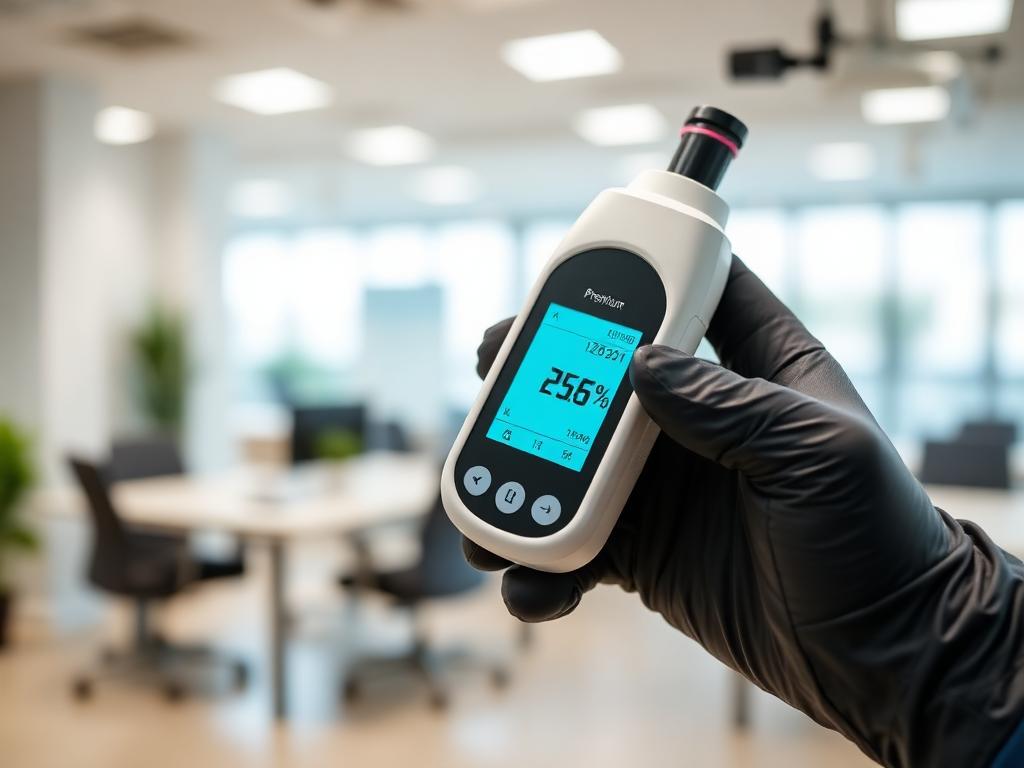 Lab-grade01
IAQ Testing
Comprehensive on-site indoor air quality testing across all key parameters.
Request inspection Spore analysis02
Airborne Mould Testing
Detect airborne mould spores, identify species & evaluate moisture risk.
Request inspection Full report03
Air Quality Inspection
Full building inspection with detailed reporting and remediation roadmap.
Request inspectionAligned with global standards
№ 04 — Why Indoor Air Matters
The invisible environment shaping how we live, work and learn.
Most people in the United Kingdom spend more than ninety percent of their time indoors — at work, in classrooms, in healthcare settings and in transport hubs. Yet the air inside many commercial and public buildings is frequently two to five times more polluted than the air outside, and in poorly ventilated spaces it can be far worse. Indoor air carries a complex mixture of fine particulates, volatile organic compounds, carbon dioxide, nitrogen dioxide, formaldehyde and bioaerosols. Each has measurable effects on cognitive performance, respiratory health, comfort and long-term occupant wellbeing.
The science is now unambiguous. Elevated CO₂ above 1,000 ppm reduces decision-making accuracy by up to fifteen percent. Chronic exposure to PM2.5 — even at concentrations once considered safe — is linked to cardiovascular disease, stroke and accelerated cognitive decline. Poorly controlled VOC and formaldehyde exposure after refurbishment can persist for weeks and drive persistent complaints in workplaces and learning environments.
Indoor Air Monitoring UK exists to make this evidence actionable. We translate guidance from CIBSE TM40, BS EN 16798-1, the WHO 2021 air-quality guidelines, BREEAM Hea 02 and the WELL Building Standard into clear monitoring programmes, investigation methods and practical reporting for facilities, property and ESG teams.
Whether you are investigating headaches and fatigue in a workplace, scoping a ventilation upgrade, preparing for a BREEAM assessment, monitoring a school during the winter heating season, or testing a new-build home for VOC off-gassing, the goal is the same: turn invisible air into measurable, manageable, healthier indoor environments. Every page on this site is written and reviewed by environmental specialists with first-hand experience of UK buildings.

Start with one breath
Make your building work for the people inside it.
Independent guidance, monitoring playbooks and ventilation expertise — all in one place.